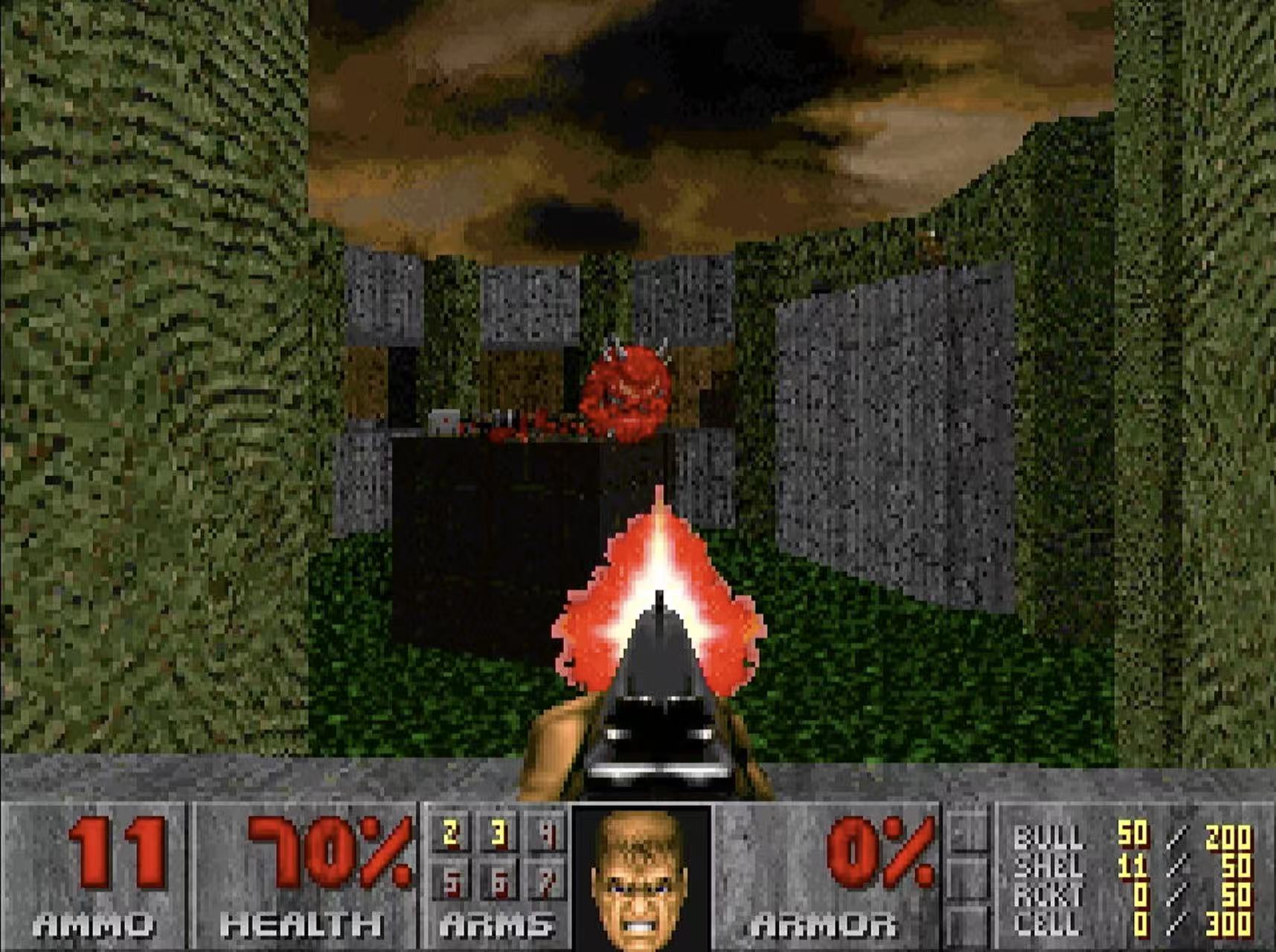
I've spent the last month adding features and improving performance in
z486_MiSTer, mostly working through
games from the first half of the 1990s. Looking a few years ahead brought me
to another change I wanted to explore: the arrival of 3D graphics cards.
The first one that left a strong impression on me was the Voodoo. The game was
Need for Speed II SE. Smooth textures, fog, and the speed of the whole thing
made it feel like a new generation of PC gaming. Could I recreate that on an FPGA
now that the z486 CPU exists?
The result of this detour is zSST, a
SystemVerilog implementation of the 3dfx Voodoo Graphics, or SST-1.
Combined with my z486 CPU and the surrounding PC hardware, it forms
z486 XL: a DOS PC with Voodoo graphics
running in the programmable logic of a Xilinx KV260 board. Tomb Raider now runs
with its original 3dfx renderer.
I released z386, an open-source 80386 CPU
core, in May and added the 80386
early-start optimization in June. Early start overlaps
address generation for one instruction with completion of its predecessor. It
was an important 386 performance feature, but it also previewed the more
systematic i486 pipeline. The
MiSTer core needed more
performance, so I continued in that direction and added further 486-class
mechanisms.
The result is z486, an open-source,
80486-class pipelined x86 CPU written in SystemVerilog. It combines hardwired,
pipelined execution for common instructions with microcode for complex
architectural behavior.
When Intel designed the 80386, they gave it a trick for hiding memory latency: Early Start. Instead of waiting for an instruction to reach its memory micro-op, the 386 begins the next instruction's address work — effective address, segment relocation, the bus cycle — in the last cycle of the current instruction. Intel put it at about 9% of overall performance. It is also the source of the POPAD bug.
The z386 FPGA core I released in May ran the original 386 microcode but didn't have early start. Over the last month I added it along with a series of other optimizations, and z386 now reaches ao486-class performance:
This is the fifth installment of the 80386 series. The FPGA CPU is now far enough along to run real software, and this post is about how it works. z386 is a 386-class CPU built around the original Intel microcode, in the same spirit as z8086.
The core is not an instruction-by-instruction emulator in RTL. The goal is to recreate enough of the original machine that the recovered 386 control ROM can drive it. Today z386 boots DOS 6 and DOS 7, runs protected-mode programs like DOS/4GW and DOS/32A, and plays games like Doom and Cannon Fodder. Here are some rough numbers against ao486:
Metric
z386
ao486
Lines of code (cloc)
8K
17.6K
ALUTs
18K
21K
Registers
5K
6.5K
BRAM
116K
131K
FPGA clock
85MHz
90MHz
3DBench FPS
34
43
Doom (original) FPS, max details
16.5
21.0
In current builds, z386 performs like a fast (~70MHz) cached 386-class machine, or a low-end 486. It runs at a much higher clock than historical 386 CPUs, but with somewhat worse CPI (cycles per instruction). The current cache is a 16 KB, 4-way set-associative unified L1, chosen partly to keep the clock high. Real high-end 386 systems often used larger external caches, typically in the 32 KB to 128 KB range.
Doom II running on z386.
Much of this 386 microarchitecture archaeology has already been covered in the previous four posts: the multiplication/division datapath, the barrel shifter, protection and paging, and the memory pipeline. z386 tries to be both an educational reconstruction and a usable FPGA CPU. It keeps many 386-like structures: a 32-entry paging TLB, a barrel shifter shaped like the original, ROM/PLA-style decoding, the Protection PLA model, and most importantly the 37-bit-wide, 2,560-entry microcode ROM. At the same time, it uses FPGA-friendly shortcuts where they make sense, such as DSP blocks for multiplication and the small fast L1 cache.
In this post, I will fill in the rest of the design: instruction prefetch, decode, the microcode sequencer, cache design, testing, how z386 differs from ao486, and some lessons from the bring-up.
The FPGA 386 core I've been building now boots DOS, runs applications like Norton Commander, and plays games like Doom. On DE10-Nano it currently runs at 75 MHz. With the core now far enough along to run real software, this seems like a good point to step back and look at one of the 80386's performance-critical subsystems: its memory pipeline.
32-bit Protected Mode was the defining feature of the 80386. In the previous post, I looked at one side of that story: the virtual-memory protection mechanisms. We saw how the 80386 implements protection with a dedicated PLA, segment caches, and a hardware page walker. This time I want to look at virtual memory from a different angle: the microarchitecture of the memory access pipeline, how address translation is made efficient, how microcode drives the process, and what kind of RTL timing the design achieves.
On paper, x86 virtual memory management looks expensive. Every memory reference seems to require effective address calculation, segment relocation, limit checking, TLB lookup, and, on a miss, two page-table reads plus Accessed/Dirty-bit updates. Yet Intel's own 1986 IEEE ICCD paper, Jim Slager's Performance Optimizations of the 80386, describes the common-case address path as completing in about 1.5 clocks. How did the 386 pull that off?
The answer is that virtual memory is not really a serial chain of checks, even if the diagrams make it look that way. It is a carefully overlapped memory pipeline that uses pre-calculation, pipelining, and parallelism to keep the common case surprisingly short.
I'm building an 80386-compatible core in SystemVerilog and blogging the process. In the previous post, we looked at how the 386 reuses one barrel shifter for all shift and rotate instructions. This time we move from real mode to protected and talk about protection.
The 80286 introduced "Protected Mode" in 1982. It was not popular. The mode was difficult to use, lacked paging, and offered no way to return to real mode without a hardware reset. The 80386, arriving three years later, made protection usable -- adding paging, a flat 32-bit address space, per-page User/Supervisor control, and Virtual 8086 mode so that DOS programs could run inside a protected multitasking system. These features made possible Windows 3.0, OS/2, and early Linux.
The x86 protection model is notoriously complex, with four privilege rings, segmentation, paging, call gates, task switches, and virtual 8086 mode. What's interesting from a hardware perspective is how the 386 manages this complexity on a 275,000-transistor budget. The 386 employs a variety of techniques to implement protection: a dedicated PLA for protection checking, a hardware state machine for page table walks, segment and paging caches, and microcode for everything else.
I’m currently building an 80386-compatible core in SystemVerilog, driven by the original Intel microcode extracted from real 386 silicon. Real mode is now operational in simulation, with more than 10,000 single-instruction test cases passing successfully, and work on protected-mode features is in progress. In the course of this work, corners of the 386 microcode and silicon have been examined in detail; this series documents the resulting findings.
In the previous post, we looked at multiplication and division -- iterative algorithms that process one bit per cycle. Shifts and rotates are a different story: the 386 has a dedicated barrel shifter that completes an arbitrary multi-bit shift in a single cycle. What's interesting is how the microcode makes one piece of hardware serve all shift and rotate variants -- and how the complex rotate-through-carry instructions are handled.
When Intel released the 80386 in October 1985, it marked a watershed moment for personal computing. The 386 was the first 32-bit x86 processor, increasing the register width from 16 to 32 bits and vastly expanding the address space compared to its predecessors. This wasn't just an incremental upgrade—it was the foundation that would carry the PC architecture for decades to come.
After 486Tang, I wanted to go back to where x86 started. The result is z8086: a 8086/8088 core that runs the original Intel microcode. Instead of hand‑coding hundreds of instructions, the core loads the recovered 512x21 ROM and recreates the micro‑architecture the ROM expects.
z8086 is compact and FPGA‑friendly: it runs on a single clock domain, avoids vendor-specific primitives, and offers a simple external bus interface. Version 0.1 is about 2000 lines of SystemVerilog, and on a Gowin GW5A device, it uses around 2500 LUTs with a maximum clock speed of 60 MHz. The core passes all ISA test vectors, boots small programs, and can directly control peripherals like an SPI display. While it doesn’t boot DOS yet, it’s getting close.